

A standard motorcycle liability policy covers damage you cause to others, but it has limits. When a claim exceeds those limits, your personal assets become vulnerable.
Motorcycle umbrella liability coverage fills that gap by providing additional protection beyond your base policy. We at Central Ohio Insurance Services, Inc. help riders understand why this extra layer matters and how to choose the right coverage for their situation.
What Motorcycle Umbrella Liability Actually Covers
How Umbrella Coverage Activates
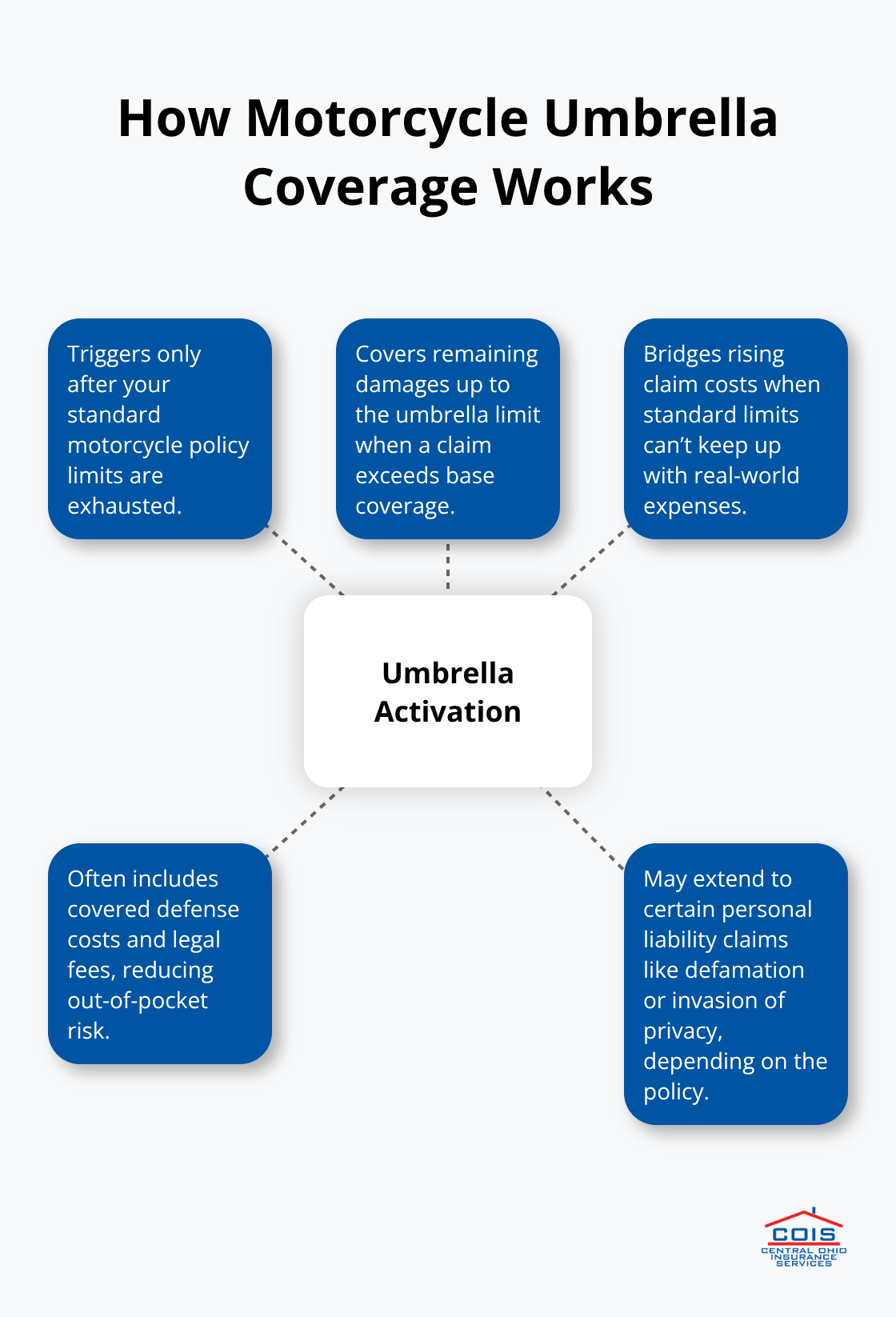
Motorcycle umbrella liability provides additional protection that activates after your standard motorcycle policy limits are exhausted. When a claim exceeds what your base policy pays, the umbrella steps in to cover the remaining damages up to its limit. This matters because motorcycle accidents frequently generate costs that standard policies cannot handle.
According to the Insurance Research Council, social inflation in auto and motorcycle liability claims has resulted in rapid increases in claim costs, meaning that even moderate accidents now routinely exceed traditional liability limits.
Real Costs That Exceed Standard Limits
A typical motorcycle policy might carry $100,000 in property damage liability and $300,000 in bodily injury liability. In a serious multi-vehicle crash, medical bills and vehicle damage can easily reach $500,000 or more. Your umbrella policy then covers the gap between what your motorcycle policy pays and the total judgment, including defense costs and legal fees. This protection extends beyond just bodily injury and property damage-some umbrella policies also cover personal liability claims like defamation or invasion of privacy that arise from your actions.
Selecting Your Coverage Limit
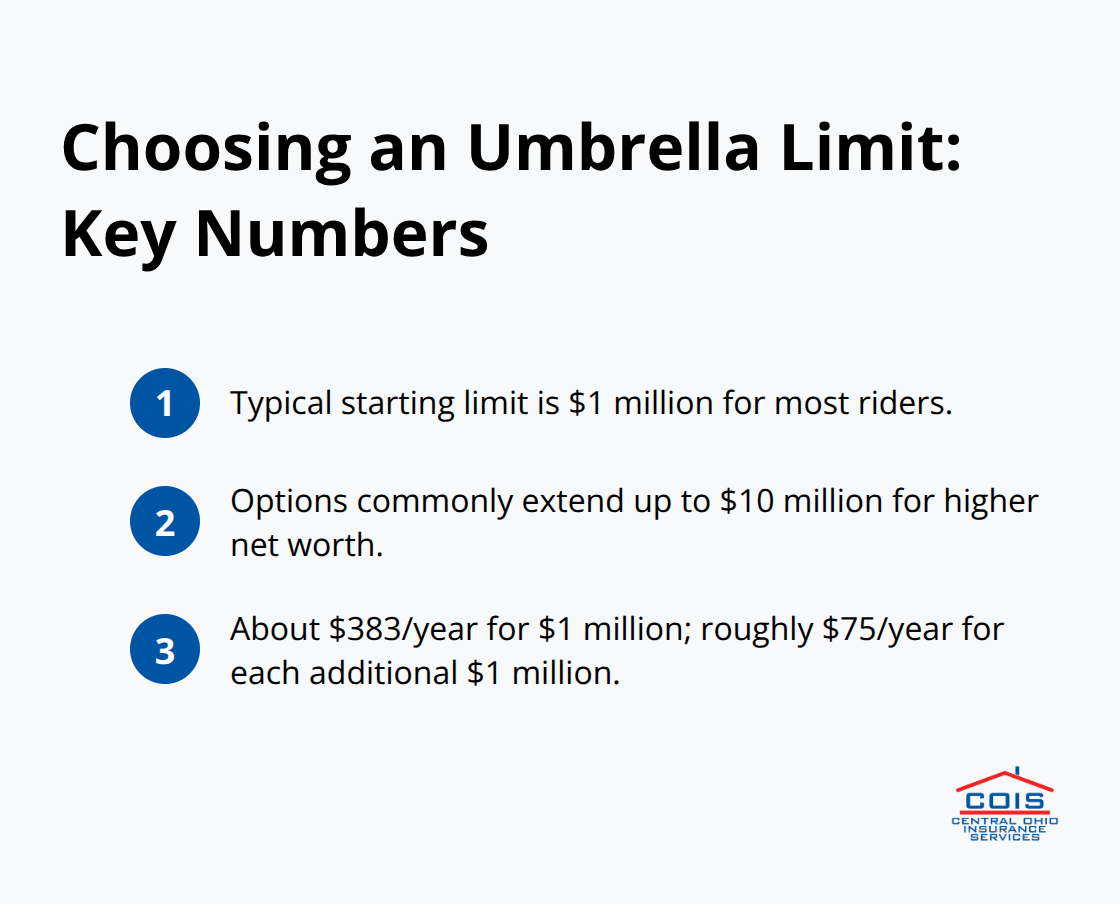
The coverage limits you choose directly determine your financial protection. Umbrella policies typically start at $1 million in coverage, with options extending to $10 million for riders with substantial assets. According to data from ACE Private Risk Services cited by Forbes, a $1 million umbrella policy costs approximately $383 per year for a standard setup, making it remarkably affordable relative to the exposure it covers. Adding an additional $1 million in coverage costs roughly $75 more annually.
Matching Coverage to Your Assets
Your choice of limit should reflect your total assets-home value, vehicles, retirement accounts, investments, and savings combined. If you own a house worth $400,000 plus $200,000 in vehicles and investments, a $1 million umbrella provides reasonable protection. However, if your net worth exceeds $1 million, you should seriously consider $2 million or higher. The umbrella only pays after your underlying motorcycle, auto, and homeowners policies are exhausted, so you must maintain adequate limits on those base policies. Most insurers require minimum underlying limits before issuing an umbrella, typically $300,000 in bodily injury and $100,000 in property damage on your motorcycle policy. Understanding these requirements helps you move forward with confidence when comparing policies from different carriers.
Why Standard Motorcycle Coverage Leaves You Exposed
The Limits That Stop Too Soon
Standard motorcycle liability policies come with fixed limits, and those limits are often far too low for real accidents. A typical motorcycle policy might include $300,000 in bodily injury liability and $100,000 in property damage liability. These numbers sound substantial until you face actual medical costs and vehicle repair bills from a serious crash. A single motorcyclist can accumulate $500,000 in medical expenses within weeks of a major accident, and if multiple vehicles or pedestrians are involved, damages climb even faster. Your standard policy pays its limit and then stops. Anything beyond that comes directly from your personal assets.
How Damages Exceed Your Policy Limits
The real problem emerges when you consider what happens after your motorcycle policy limit is exhausted. Defense costs alone can consume $100,000 or more in a contested liability case, and these costs often come out of your pocket before any settlement or judgment is reached. Medical testimony, expert witnesses, and litigation against multiple defendants drive costs far beyond what most riders anticipate. A serious accident can generate $2 million, $5 million, or higher in total damages. Without umbrella coverage, a single incident could force you to liquidate retirement accounts, sell your home, or face wage garnishment for years.
The Cost of Protection Versus the Cost of Exposure
A $1 million umbrella policy costs roughly $20 per month according to industry data, yet it protects against claims that could total far more. This protection extends beyond just bodily injury and property damage-some umbrella policies also cover personal liability claims like defamation or invasion of privacy. The Insurance Research Council has documented that social inflation continues to push liability claim costs upward, meaning the gap between standard limits and actual damages keeps widening. Riders frequently underestimate their exposure because they think about the accident itself rather than the legal machinery that follows.
Matching Your Assets to Your Protection
If you own a home worth $300,000 or have retirement savings approaching six figures, an umbrella isn’t an extravagance-it’s the difference between weathering a major claim and losing everything you’ve built. Your choice of coverage limit should reflect your total assets (home value, vehicles, retirement accounts, investments, and savings combined). Most insurers require minimum underlying limits before issuing an umbrella, typically $300,000 in bodily injury and $100,000 in property damage on your motorcycle policy. Understanding these requirements helps you move forward with confidence when comparing policies from different carriers. The next step involves assessing your specific assets and determining what coverage level actually protects your financial future.
Picking the Right Coverage Limit for Your Situation
Calculate Your Total Assets First
Start by totaling your actual assets, not guessing at what sounds reasonable. Add your home value, vehicle values, retirement account balances, investment accounts, savings, and any other property with significant worth. If your total comes to $800,000, a $1 million umbrella provides solid protection. If you reach $2 million or higher, you need $2 million or more in umbrella coverage. This isn’t theoretical-it’s direct math.
Your umbrella limit should roughly match or exceed your net worth because a judgment can attach to everything you own. Most umbrella policies start at $1 million in coverage, and according to ACE Private Risk Services data cited by Forbes, that $1 million costs approximately $383 annually for a standard setup with one home and two vehicles. Adding another $1 million in coverage runs about $75 more per year, making higher limits surprisingly affordable.
Understand the Real Cost of Underinsurance
The real cost of skipping this step shows up when you face a $1.5 million judgment and your umbrella maxes out at $1 million-you’re personally liable for the $500,000 difference. That gap can force you to liquidate retirement accounts, sell assets, or face wage garnishment for years. The premium you pay for umbrella coverage ($20 to $30 monthly for $1 million) protects against exposure that could devastate your financial future.
Verify Your Underlying Policy Limits
Before you request quotes, verify your underlying policy limits because most insurers won’t issue an umbrella without minimums in place. Your motorcycle policy typically needs $300,000 in bodily injury liability and $100,000 in property damage liability. Your homeowners policy usually requires $300,000 in liability coverage. If your current policies fall below these thresholds, raise them first-it’s cheaper than you think and necessary to activate umbrella protection anyway.
Compare Quotes and Review Exclusions
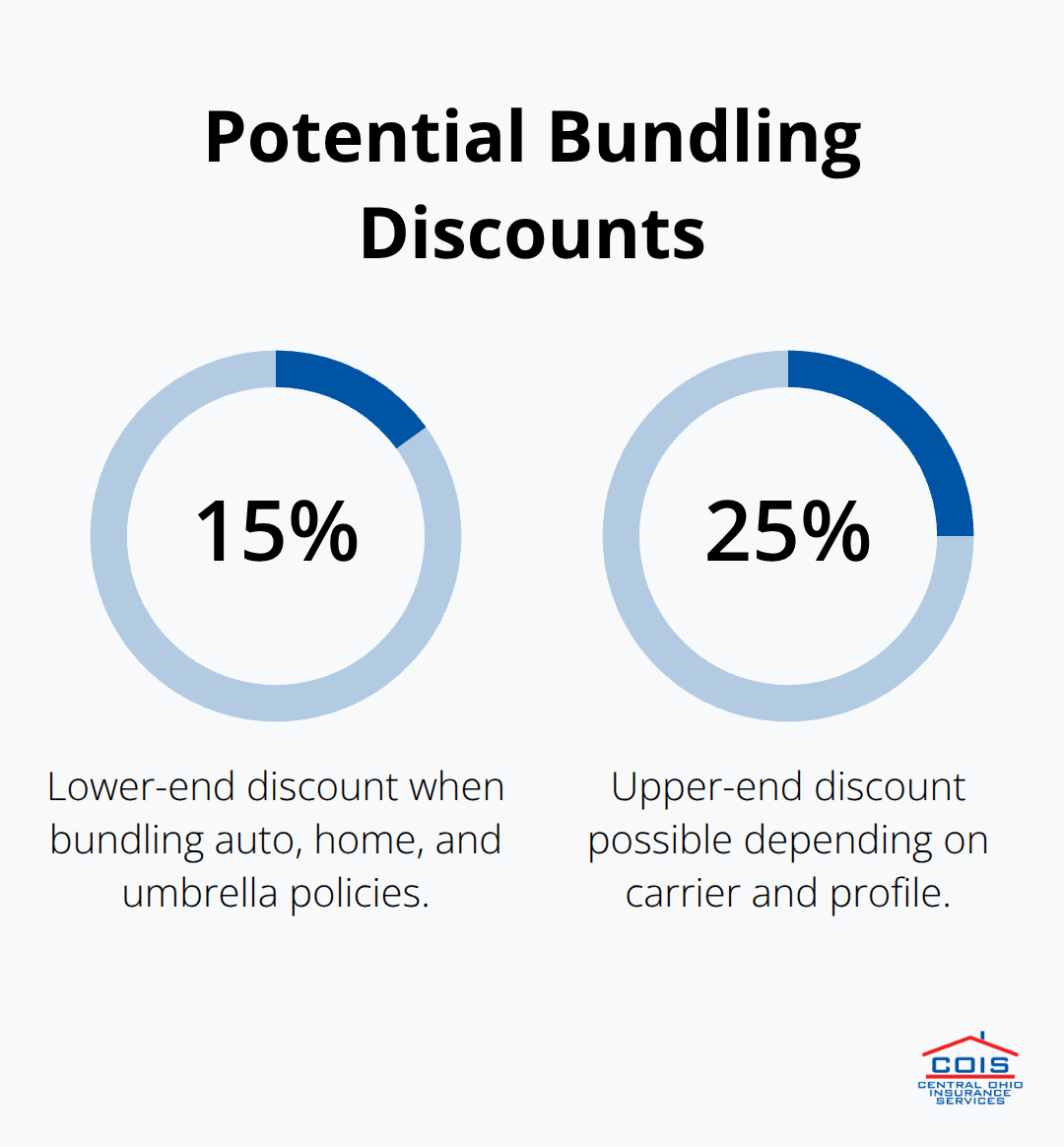
Contact at least three carriers because pricing varies significantly based on your location, driving history, number of vehicles, and claims history. Some insurers offer substantial discounts for bundling umbrella with auto and home policies, sometimes reducing the total cost by 15 to 25 percent. Read the policy exclusions carefully because umbrella policies don’t cover your own injuries, damage to your own property, intentional acts, or business use of your motorcycle.
If you operate a motorcycle repair business or conduct riding tours, you need commercial umbrella coverage instead, which extends up to $25 million for business operations. A local independent insurance agency can shop multiple carriers to find competitive rates and help you navigate these requirements without the confusion that comes from working with a single insurer.
Final Thoughts
Motorcycle umbrella liability coverage protects your assets when a serious accident generates damages beyond your standard policy limits. A single crash can produce hundreds of thousands of dollars in liability exposure, and without this extra layer of protection, you risk losing your home, retirement savings, and future income to a judgment. The financial reality is straightforward: a $1 million umbrella policy costs roughly $20 monthly, making it one of the most cost-effective ways to safeguard what you’ve built.
Your next step involves calculating your total assets, verifying your underlying motorcycle and homeowners policy limits meet minimum requirements ($300,000 in bodily injury liability and $100,000 in property damage on your motorcycle policy), then requesting quotes from multiple carriers. Bundling your umbrella with auto and home policies often reduces your total premium by 15 to 25 percent, so shopping around matters significantly. We at Central Ohio Insurance Services, Inc. help riders in Ohio navigate this process without confusion by shopping multiple carriers to find competitive rates and solutions tailored to your specific situation.
Our licensed team handles the details-verifying your underlying limits, explaining policy exclusions, and ensuring you understand exactly what your motorcycle umbrella liability coverage protects. Contact Central Ohio Insurance Services, Inc. today to discuss your options and get protected.
The information provided in this blog is for general informational purposes only and does not constitute legal, financial, or insurance advice. Coverage options, terms, and availability may vary. Please consult with a licensed professional for advice specific to your situation. Artificial intelligence may have been used to generate text and images in some blog articles and may contain inacuracies.