

Most Ohio drivers leave hundreds of dollars on the table every year by sticking with their current insurer. At Central Ohio Insurance Services, Inc., we’ve seen firsthand how comparing auto insurance quotes can reveal price differences that shock our clients.
The good news is that getting multiple quotes takes less time than you might think. A few phone calls or online forms can uncover savings that add up year after year.
Why Shopping Around Saves Real Money
Most Ohio drivers never call a second insurer. They renew with their current carrier year after year, assuming the price stays fair. That assumption costs them hundreds of dollars annually. Experian data from May 2026 shows the average Ohio driver pays around $1,718 per year for auto insurance, but that figure masks enormous variation. A driver who requests quotes from just three carriers can find price differences exceeding $400 to $500 per year for identical coverage. One driver might pay $1,251 annually with Lemonade while another pays $1,594 with National General-both offering full coverage in Ohio. That $343 gap represents real money that vanishes if you never compare.
The Hidden Cost of Loyalty
Insurance companies count on inertia. They know most customers won’t shop around, so they gradually raise rates year after year. Carriers like Liberty Mutual report that new customers who switch policies save over $700 annually, with some reporting savings of $1,121 compared to GEICO, $997 versus Progressive, and $1,161 versus State Farm. These aren’t theoretical numbers-they reflect actual quote data from drivers making the switch. Your current insurer has no reason to offer you their best rate if you’ve never threatened to leave. The moment you request quotes elsewhere, suddenly your renewal notice looks different. Discounts appear that weren’t visible before. Rates drop. When clients bring us their current declarations pages, we observe this pattern constantly. What you pay today has almost nothing to do with what you could pay tomorrow.
Discounts Vanish When You Stop Looking
Every insurance company offers discounts that don’t automatically apply to your policy. Online purchase discounts, bundling discounts for combining auto with home or renters coverage, safe driver discounts, and low-mileage discounts all require you to ask for them or qualify through specific actions. Many Ohio drivers miss these entirely because they never shop competing quotes. When you request quotes from multiple carriers, you force each one to show you what they can actually offer. One insurer might emphasize their bundling discount, cutting your total cost by 15 percent when you combine policies. Another might highlight their RightTrack program, which can deliver savings for good driving. A third might offer an online-purchase discount worth $50 to $100. You’ll never know these options exist unless you ask three to five different companies for quotes using identical coverage limits and deductibles.
What Comparison Actually Reveals
The comparison does more than expose price differences. It shows which carrier values your specific situation most. One company might offer superior rates for bundled policies while another specializes in low-mileage drivers. A third might provide better pricing for drivers with clean records.
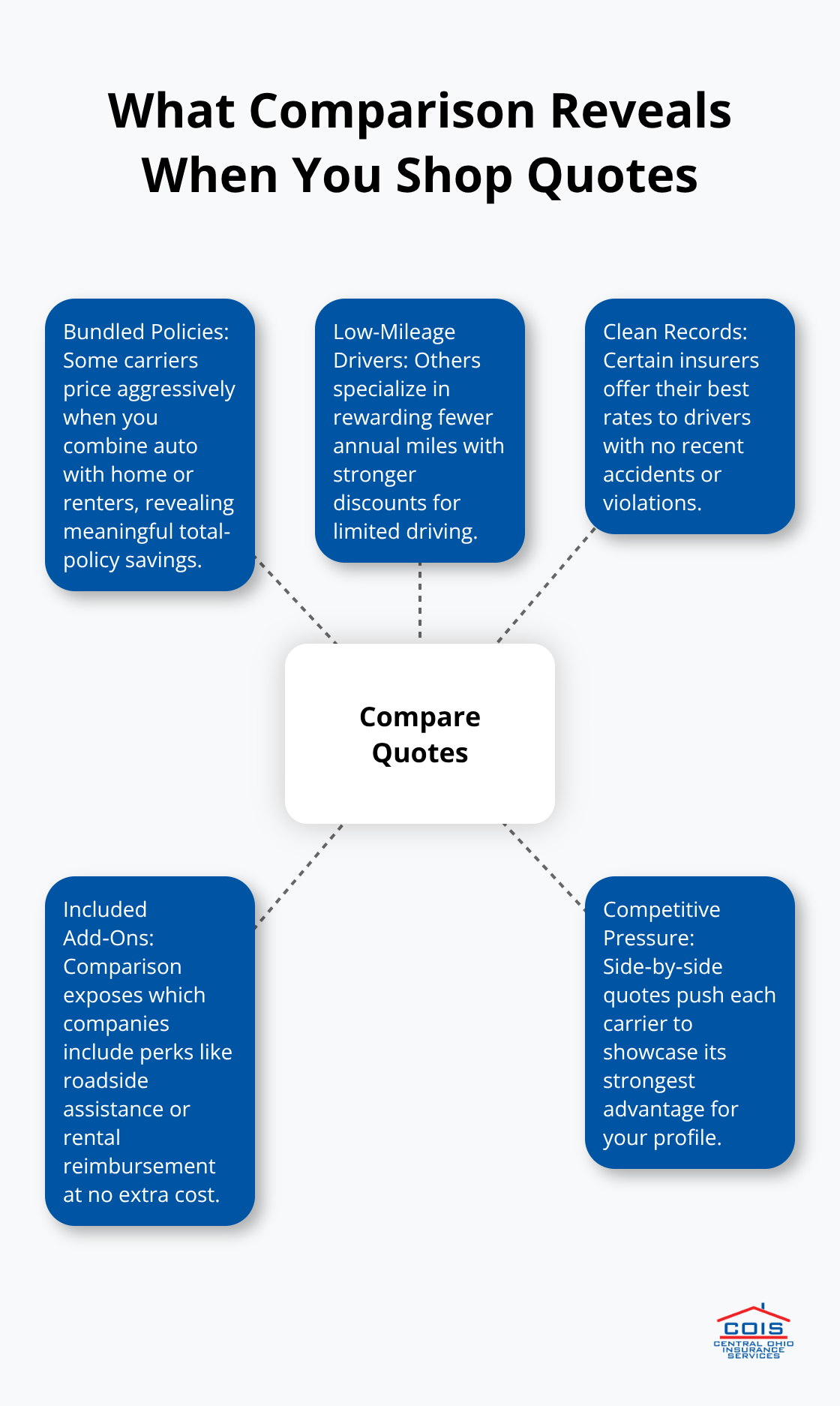
When you place identical requests with multiple insurers, each one competes to win your business by highlighting their strongest advantages. This competition works in your favor. The insurer that offers the best rate for your profile emerges clearly. You also spot which carriers include valuable add-ons like roadside assistance or rental reimbursement at no extra cost. These details matter when you’re comparing coverage limits and deductibles side by side, not just the bottom-line premium.
Your Next Step Toward Real Savings
The path to lower premiums starts with a single decision: request quotes from at least three to five different carriers this week. Prepare your current policy details, vehicle information, and driving history. Use the same coverage limits and deductibles across all quotes so you’re truly comparing apples to apples. This effort takes roughly 30 minutes and can uncover hundreds of dollars in annual savings. Once you have those quotes in hand, you’ll see exactly where your current insurer stands against the competition.
What Really Drives Your Auto Insurance Price
Your driving history is the single most powerful factor determining what you pay for auto insurance in Ohio. Experian data shows a clean driving record costs around $1,570 per year. One accident or violation doesn’t just disappear after a year; insurers review three years of driving history through your Motor Vehicle Record, and each incident compounds the damage. This isn’t negotiable across carriers-every insurer sees the same MVR data and adjusts your rate accordingly. What you can control is whether you disclose all household drivers when requesting quotes. Omitting a driver now creates a catastrophic problem later when the insurer discovers the omission during a claim and cancels your policy entirely. Disclose everyone who drives your car, including teenage drivers, because their inexperience will increase your premium significantly but won’t destroy it if you’re upfront from the start.
Your Vehicle Shapes Your Premium
The specific car you drive shapes your premium as much as your driving record does. Insurers examine your vehicle’s age, safety ratings, repair costs, and theft risk. A newer sedan with high safety marks and inexpensive parts costs less to insure than an older sports car or a model frequently targeted by thieves. Ohio ranks among the top ten states for auto theft according to the National Insurance Crime Bureau, which means theft coverage costs more here than in safer states. If you’re shopping for a new vehicle, check insurance costs before you buy-don’t wait until you’ve already signed the paperwork. Annual mileage also affects your rate substantially. A driver logging 5,000 miles annually qualifies for low-mileage discounts that can trim hundreds from the yearly cost, while someone driving 15,000 miles pays significantly more. When you request quotes, provide accurate mileage estimates because insurers verify this information and adjust your premium if they discover you’ve underestimated.
Coverage Limits and Location Create Price Swings
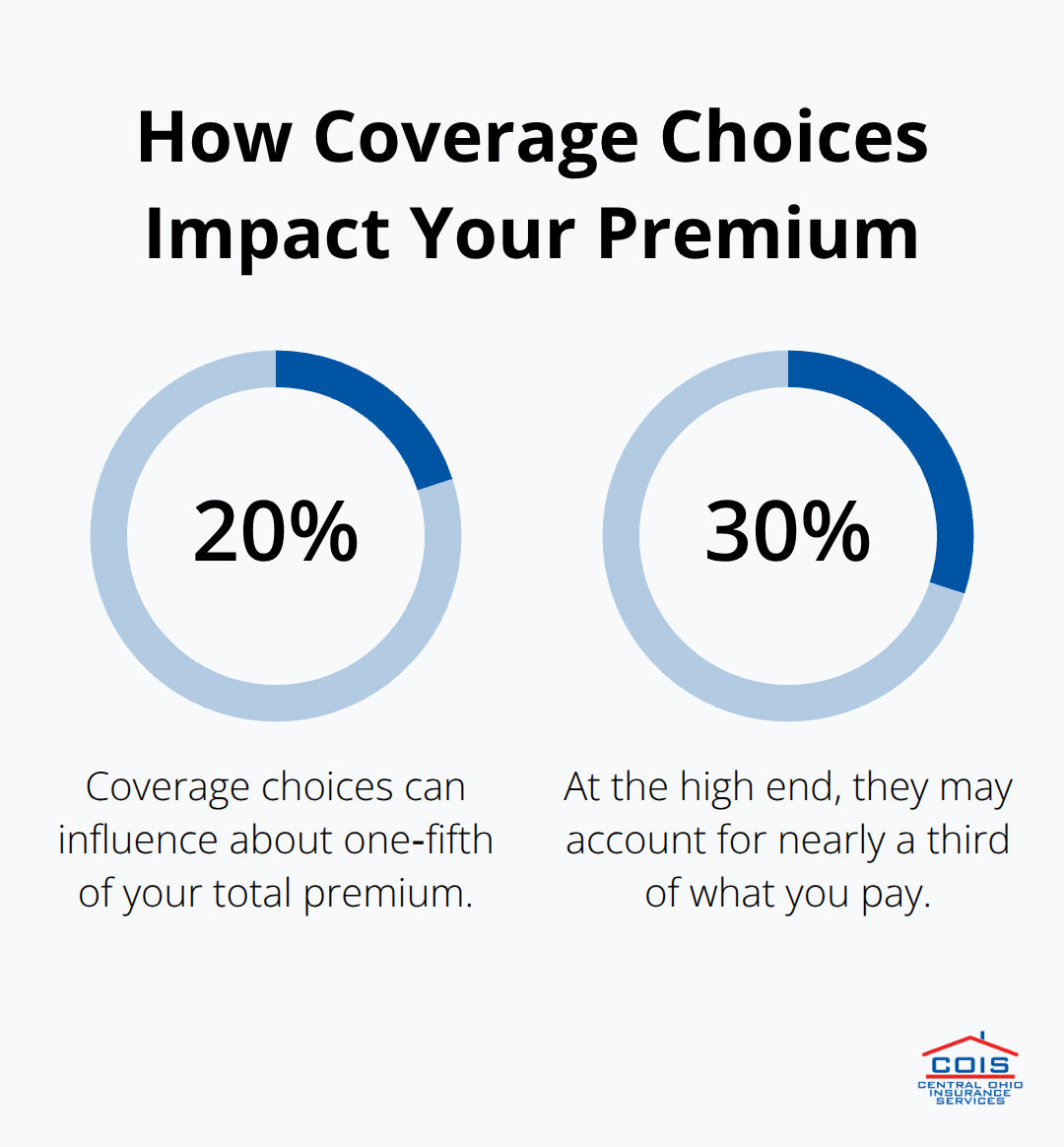
The coverage limits and deductibles you select determine roughly 20 to 30 percent of your final premium. Ohio requires a minimum of $25,000 bodily injury liability per person, $50,000 per accident, and $25,000 property damage, but these minimums leave you dangerously exposed. Choosing $50,000 bodily injury limits instead of the minimum adds modest cost but protects your assets if you injure someone seriously.
Your deductible choice creates immediate trade-offs: a $500 deductible costs more monthly than a $1,000 deductible, but you pay less out-of-pocket when you file a claim. Try a deductible you can actually afford to pay, because choosing a $250 deductible you can’t cover defeats the purpose entirely. Location within Ohio creates surprising variation because premiums reflect local accident frequency, theft rates, and repair shop costs. Urban areas like Columbus and Cleveland typically cost more than rural regions, and even neighborhoods within the same city show differences. Your ZIP code matters as much as your driving record when comparing quotes, so don’t assume quotes from friends in other Ohio cities will match yours.
How These Factors Work Together
Each factor-driving history, vehicle type, coverage choices, and location-operates independently, yet they interact to shape your final rate. A clean-driving urban resident with a high-theft-risk vehicle pays more than a rural driver with the same record and a safer car. These combinations explain why two Ohio drivers with seemingly similar profiles receive wildly different quotes. When you request quotes from multiple carriers, you’ll see how each company weights these factors differently. One insurer might penalize your location heavily while another focuses more on your vehicle’s safety rating. This variation is why shopping around reveals which carrier offers the best value for your specific situation-not just the lowest price, but the rate that reflects what you actually drive and where you actually live.
Getting Quotes That Actually Compare
Choose Your Quote Method Wisely
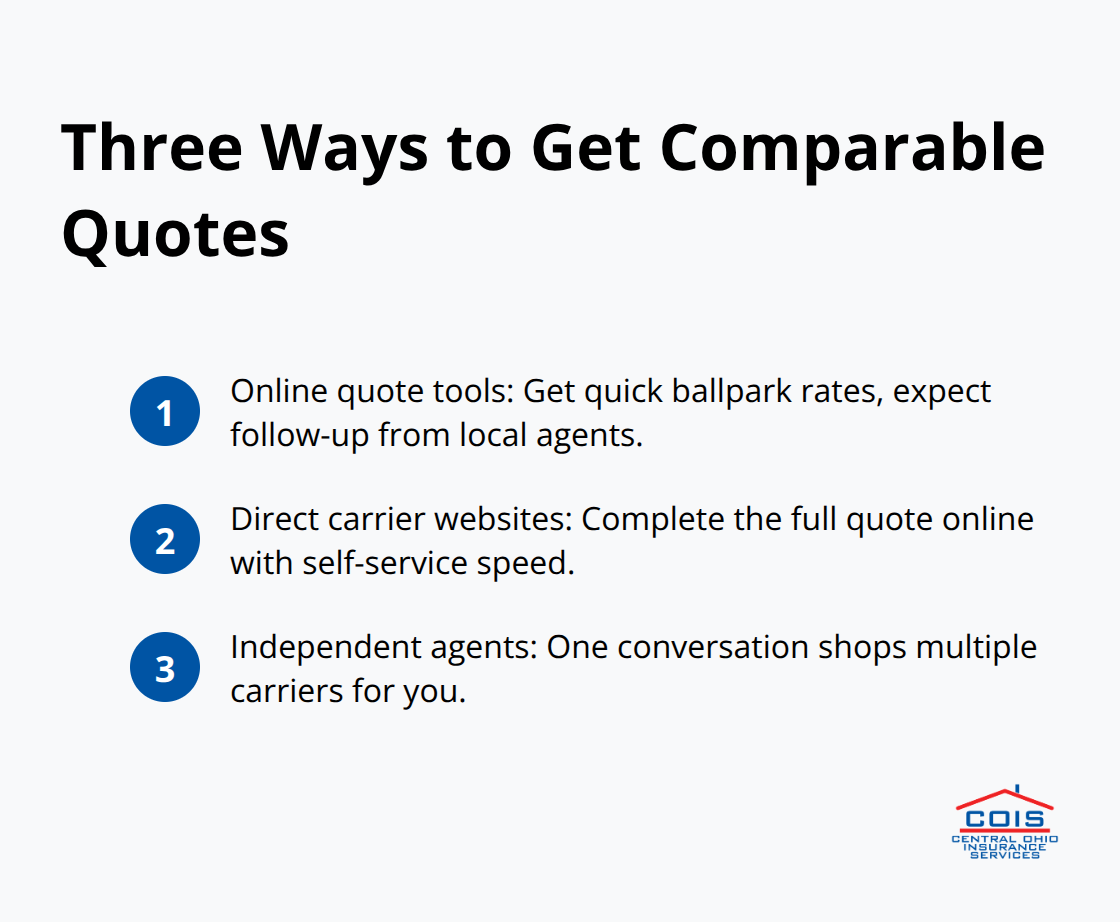
Start with at least three to five different carriers, but the method you select matters more than the number. Online quote tools deliver speed when you need immediate ballpark figures, though they often route your information to local agents who follow up with calls or emails. Direct carrier websites like Lemonade or Nationwide let you complete the entire quote process online without agent contact, which accelerates things if you prefer self-service. Independent agents shop multiple carriers simultaneously and can provide quotes from five or more companies in a single conversation, eliminating the repetitive work of filling out identical forms five separate times. The trade-off is straightforward: online tools offer speed and control, while independent agents offer convenience and expertise. For most Ohio drivers, the agent route eliminates hours of duplicate data entry and prevents oversights. When you request quotes, prepare your current policy declarations page, vehicle registration, driver’s licenses for all household drivers, and a realistic estimate of your annual mileage. Experian data shows that accurate mileage matters because underestimating miles invites premium adjustments later when insurers verify the information.
Match Coverage Across All Quotes
The comparison only works if every quote uses identical coverage limits and deductibles. This sounds obvious but trips up most drivers. Request quotes with Ohio’s $25,000 bodily injury per person and $50,000 per accident minimums if you want to see the absolute floor price, but also request quotes at $50,000/$100,000 limits so you can see the real cost difference between minimum and moderate protection. Set the same deductible across all quotes-typically $500 or $1,000-so price variations reflect carrier differences, not coverage differences. Many drivers skip this step and end up comparing a $250-deductible quote from one company against a $1,000-deductible quote from another, making it impossible to know which insurer actually offers better value.
Look Beyond the Premium Number
Once quotes arrive, review what’s included beyond the premium. Some carriers bundle roadside assistance, rental car reimbursement, or digital tools at no extra charge, while others charge $50 to $100 annually for these additions. The GEICO mobile app lets you access ID cards, pay bills, and file claims instantly, which carries real value if you want digital-first policy management. Lemonade’s streamlined app and claims process appeal to drivers who want simplicity over agent interaction. Compare these features alongside price because the lowest premium doesn’t always deliver the best overall value when you factor in what’s actually included. An independent agent can highlight these differences and help you weigh them against the bottom-line cost, ensuring you understand exactly what each quote provides.
Final Thoughts
Comparing auto insurance quotes takes roughly 30 minutes and can save you hundreds of dollars annually. Most Ohio drivers never invest that time, which means they overpay year after year while their current insurer gradually raises rates. The math is simple: request quotes from three to five carriers using identical coverage limits and deductibles, then pick the one that delivers the best value for your situation.
Insurance rates shift constantly due to claims experience, vehicle age, driving record changes, and carrier pricing adjustments. What was the best deal last year might not be this year. Ohio drivers who shop annually uncover savings that compound over time, with one year yielding $300 in savings while a different carrier offers the better rate the next year-over five years, that discipline adds up to thousands of dollars in your pocket instead of your insurer’s.
An independent agent eliminates the repetitive work of filling out identical forms with multiple companies. When you’re ready to compare auto insurance quotes, Central Ohio Insurance Services, Inc. can show you exactly where you stand against the market and help you understand which coverage options make sense for your vehicle, driving habits, and financial situation.
The information provided in this blog is for general informational purposes only and does not constitute legal, financial, or insurance advice. Coverage options, terms, and availability may vary. Please consult with a licensed professional for advice specific to your situation. Artificial intelligence may have been used to generate text and images in some blog articles and may contain inacuracies.