

Finding the right auto insurance in Ohio means balancing coverage requirements, affordability, and protection that actually fits your needs. We at Central Ohio Insurance Services, Inc. know that choosing the best auto insurance for 2026 doesn’t have to be overwhelming.
This guide walks you through what coverage matters most, which providers offer competitive rates in our region, and how to compare quotes without wasting time. You’ll have everything you need to make a confident decision.
What Coverage Actually Protects You in Ohio
Understanding Ohio’s Minimum Requirements and Why They Fall Short
Ohio requires minimum liability coverage of $25,000 for injury/death of one person, $50,000 for injury/death of two or more people, and $25,000 for property damage. This is well below what most financial advisors recommend, and frankly, it’s inadequate for protecting your assets. If you cause an accident that injures someone seriously or damages expensive property, these minimums won’t cover the damages. A lawsuit could follow, and your personal savings and future income become vulnerable.
We at Central Ohio Insurance Services, Inc. typically recommend at least $100,000/$300,000/$100,000 limits for drivers with any meaningful assets. The cost difference between minimum and these higher limits is minimal-often just $10–20 per month-yet the protection difference is massive.
Collision, Comprehensive, and Your Vehicle’s Value
Collision and comprehensive coverage protects your own vehicle rather than the other party’s property. Collision covers damage from accidents with other vehicles or objects, while comprehensive handles theft, weather, vandalism, and animal strikes. Most lenders require full coverage if you finance or lease a car.
If your vehicle is worth less than $10,000, the premium for collision and comprehensive may exceed the vehicle’s value, making it worth dropping these coverages and raising your liability limits instead. This trade-off protects your finances more effectively than spreading thin across multiple coverage types.
Deductibles: The Trade-Off Between Monthly Cost and Out-of-Pocket Risk
Deductibles directly impact your monthly premium. A $500 deductible costs significantly less than a $250 deductible, but you’ll pay that $500 out of pocket if you file a claim. The key is choosing a deductible you can actually afford to pay without financial stress.
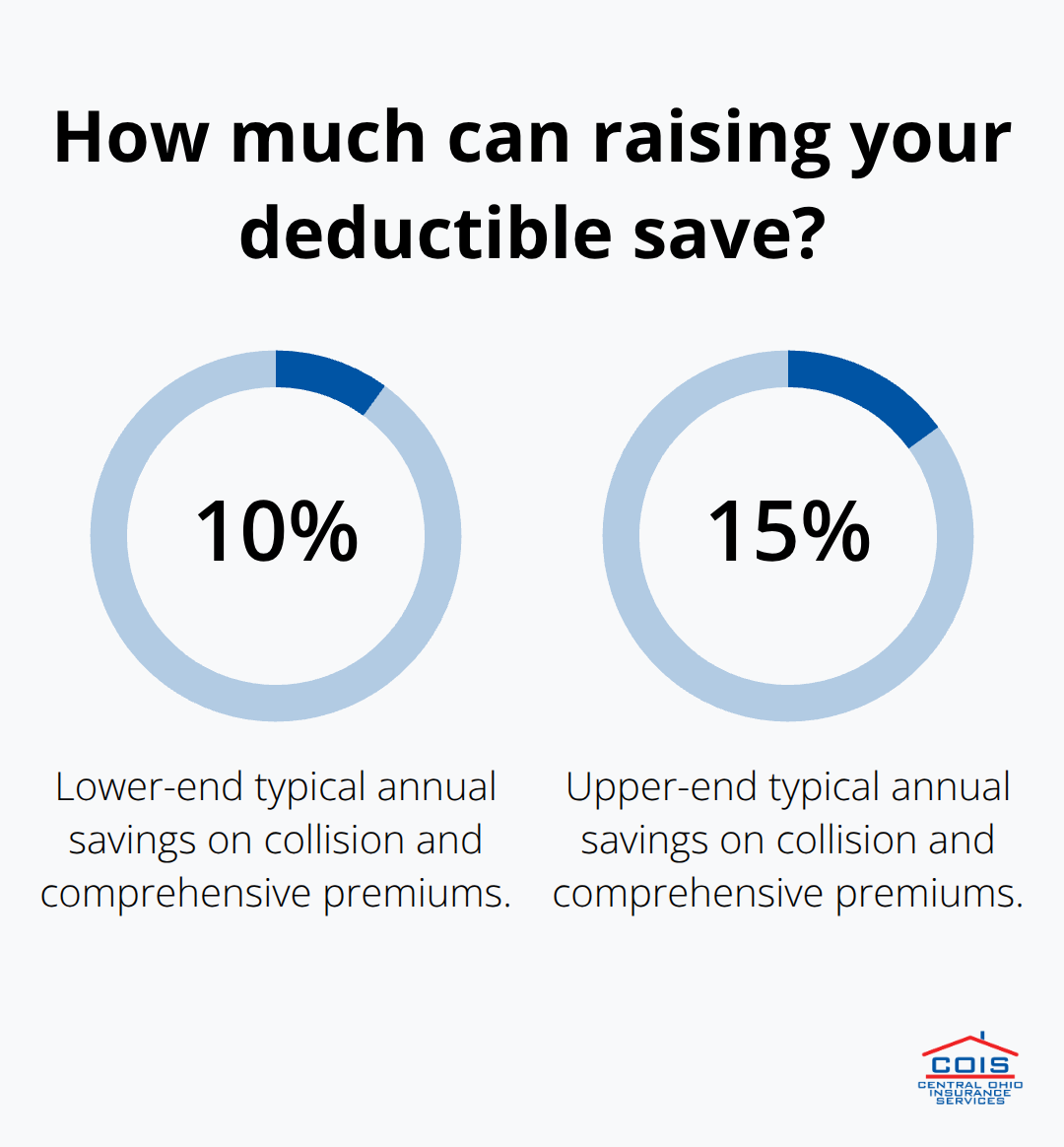
According to data from Quadrant Information Services analyzing over 120 million rates across all U.S. ZIP codes, drivers who raise their deductible from $250 to $500 typically save 10–15% on collision and comprehensive premiums annually. For a driver paying $1,200 per year for these coverages, that’s $120–$180 in savings. However, if you can’t comfortably cover a $500 deductible in an emergency, stick with the lower option.
Medical and Uninsured Driver Protection
Medical payments coverage, or MedPay, pays medical bills after an accident regardless of fault-yours or someone else’s. This covers you, your passengers, and even pedestrians you hit. In Ohio, this is optional but valuable if your health insurance has high deductibles or gaps.
Uninsured and underinsured motorist coverage protects you if the other driver lacks sufficient insurance or flees the scene. According to the Insurance Research Council, roughly 20.4% of drivers in Ohio’s neighboring state of California were uninsured in 2023, with the national uninsured rate around 15.4%. Ohio’s uninsured rate sits somewhere in that range, making this coverage genuinely important. If an uninsured driver causes a serious accident, your own liability insurance won’t help you recover medical costs or vehicle damage. This coverage costs very little-often $5–15 per month-relative to the protection it provides.
Matching Coverage to Your Specific Situation
Your age, driving history, and vehicle all affect which coverage makes sense. Younger drivers under 25 face significantly higher premiums across all coverage types and benefit most from higher deductibles to reduce monthly costs. Drivers with clean records over several years can safely raise deductibles without excessive risk. Older vehicles worth under $5,000 rarely justify collision and comprehensive premiums that approach the vehicle’s value. New or financed vehicles almost always require full coverage due to lender requirements, but even then, you control the deductible level.
Most drivers make one of two mistakes: they choose coverage they don’t need, or they spread themselves too thin with minimum limits that leave them exposed. The right approach balances affordability with genuine protection for your financial situation. Once you understand what coverage fits your needs, the next step is identifying which providers actually deliver competitive rates in your region.
Who Offers the Best Rates in Ohio Right Now
National Carriers That Compete on Price
Travelers stands out as the cheapest large auto insurer for full coverage in 2026, averaging about $139 per month or $1,664 annually according to NerdWallet’s analysis of over 120 million rates. For Ohio drivers, this pricing advantage translates to real savings without sacrificing financial strength or claims handling. Travelers also offers add-ons like gap coverage and new car replacement in many states, plus rideshare coverage where available.
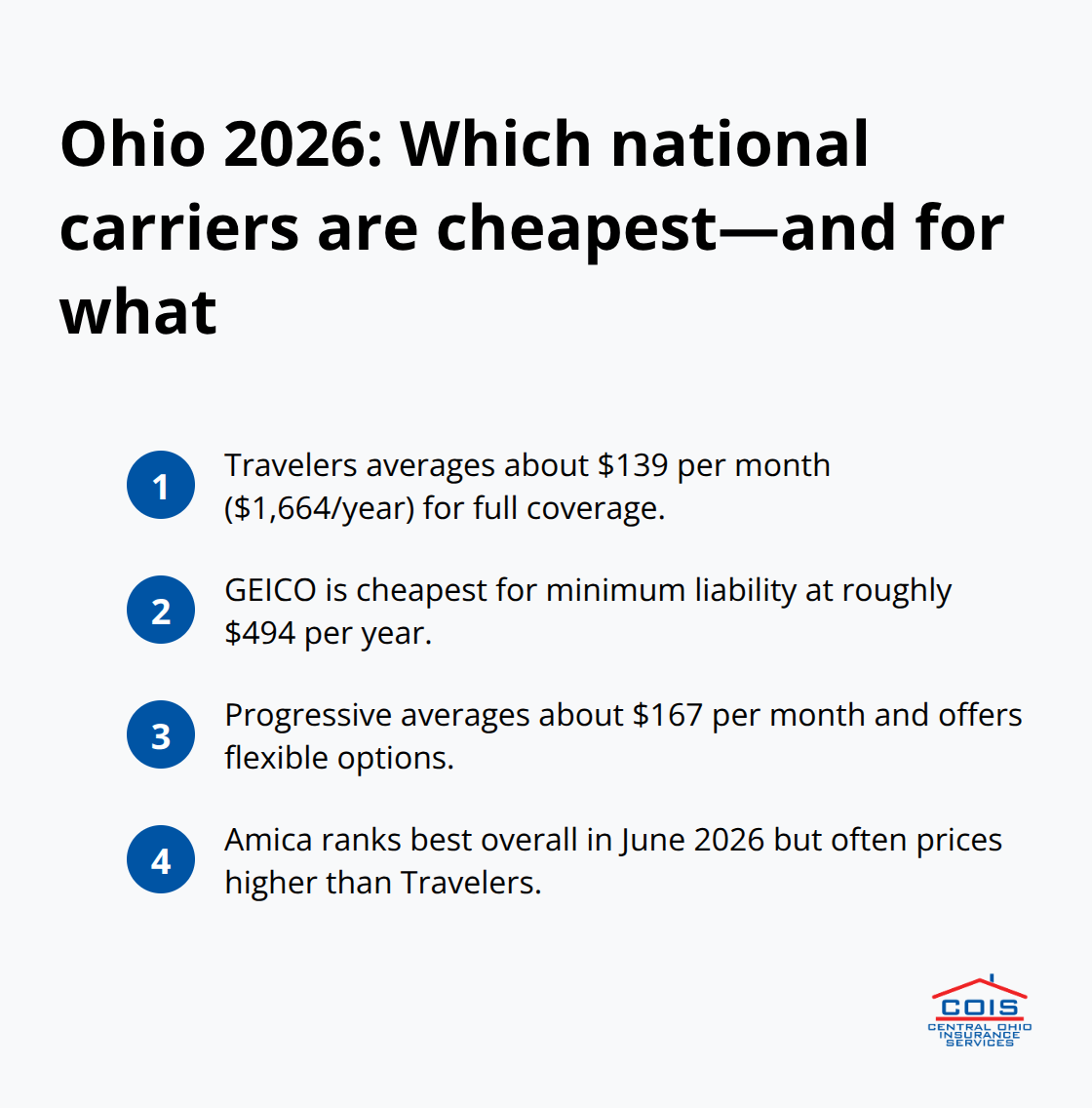
GEICO ranks as the cheapest option for drivers who only want minimum liability coverage, with median annual rates around $494, making it worth a quote if you insure an older vehicle or have limited assets to protect.
Progressive averages about $167 per month for full coverage and excels for drivers who want flexibility. Their three accident-forgiveness programs vary by state, and they include pet-injury reimbursement and strong online tools that let you adjust coverage instantly. Amica, ranked as best overall company for June 2026, scores highest on financial strength with AM Best ratings and has the fewest consumer complaints relative to its size, though its rates tend higher than Travelers for standard profiles.
Military and Specialized Options
For Ohio drivers with military ties, USAA averages roughly $132 per month or $1,584 annually, but eligibility is limited to active duty, veterans, and their families, so verify your status before pursuing their rates. Nationwide averaged about $2,397 annually and specializes in drivers with poor credit, which matters if that describes your situation. State Farm emphasizes its Steer Clear program for young drivers and usage-based pricing through its Steer Clear app, though it offers fewer add-ons than Progressive.
How Your Profile Affects What You Pay
Your specific ZIP code, age, driving history, and vehicle type create enormous rate variation. A 20-year-old driver pays roughly $297 per month for full coverage while a 40-year-old pays about $132 per month with the same insurer. After a speeding ticket, Travelers stays cheapest at roughly $180 per month, and after a DUI, Progressive becomes the most affordable at about $228 per month. This means your driving record isn’t permanent-different insurers price violations differently, and shopping around after a violation can reveal significant savings.
Location within Ohio matters too; rates in urban areas like Columbus typically run higher than rural counties due to accident frequency and theft rates. Mercury Insurance operates in Ohio and California, offering ride-share coverage, roadside assistance, and rental reimbursement, plus discounts for bundling home and auto policies.
Getting Multiple Quotes and Finding Hidden Discounts
Rate differences are substantial-a driver might save $300 to $600 annually just by comparing options. When you contact a local independent agent, you avoid the hassle of filling out separate online forms for each company. Gathering quotes from Travelers, GEICO, Progressive, and one or two regional carriers takes time, but comparing not just price but also the specific discounts available to you makes the effort worthwhile.
Bundling with home insurance, paying in full upfront, maintaining continuous coverage, or having safety features in your vehicle often yields 10 to 25 percent discounts that insurers don’t always advertise prominently. These discounts can swing your decision between carriers, so ask each company what applies to your situation. Once you’ve narrowed down which carriers offer the best rates for your profile, the next step involves understanding how to compare those quotes side-by-side without missing critical details.
Comparing Quotes Without Wasting Time
Set Your Coverage Specifications First
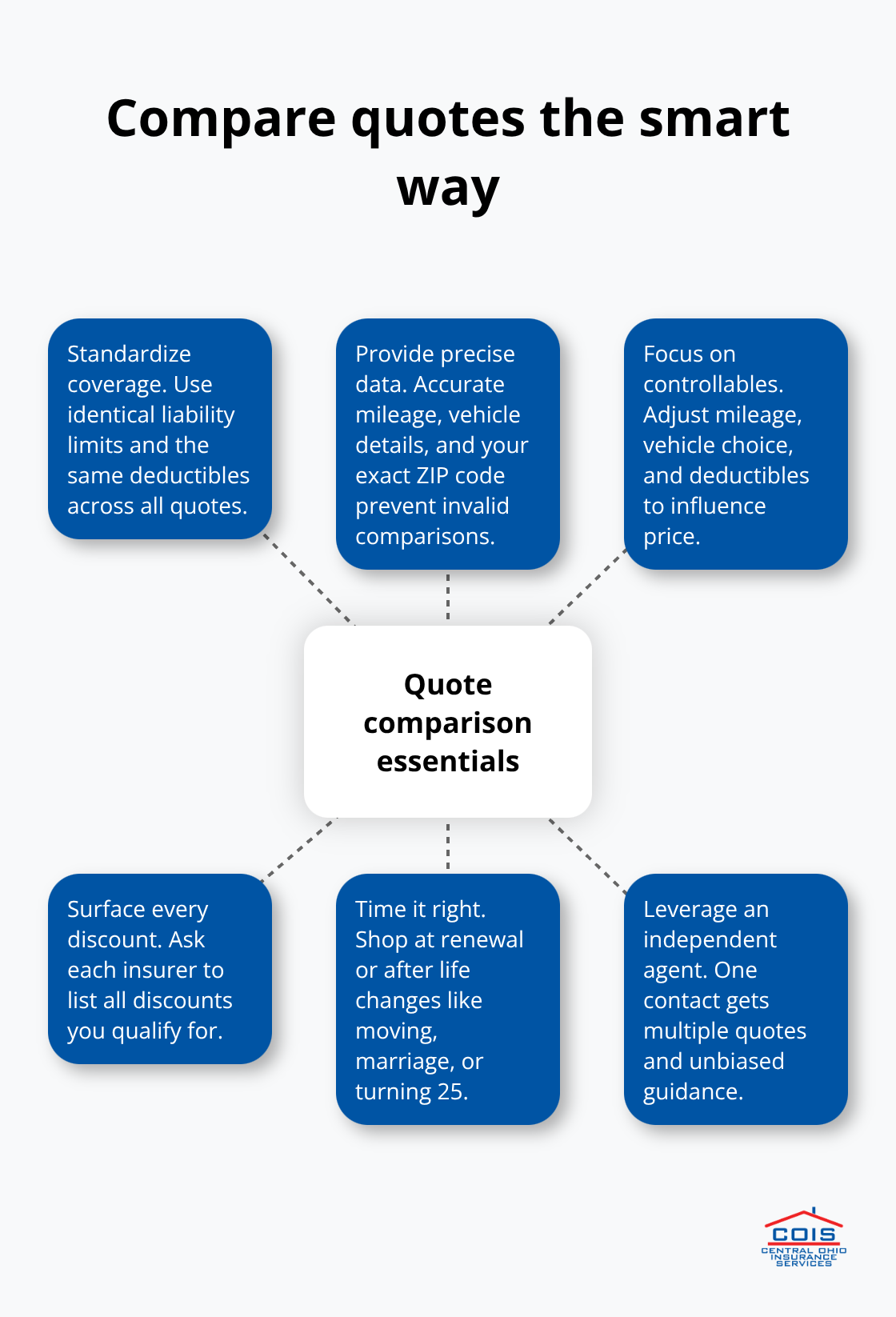
Accurate information upfront determines whether your quotes are actually comparable. You need the same coverage limits and deductibles across every quote you collect. If one quote includes $100,000/$300,000 liability limits with a $500 deductible and another shows $25,000/$50,000 limits with a $250 deductible, the price difference tells you nothing useful. Decide on your target coverage: liability limits, collision and comprehensive deductibles, whether you want personal injury protection or uninsured motorist protection, and any add-ons like roadside assistance. Write these specifications down before requesting quotes.
Provide Accurate Information to Insurers
Most insurers ask for your driving history, current coverage details, vehicle information, and annual mileage. You must provide accurate mileage estimates since underreporting triggers policy cancellations if claims reveal you actually drive more. Your ZIP code matters enormously; a Columbus address produces different rates than a rural Ohio county, so don’t generalize quotes across the state. Quadrant Information Services data analyzing over 120 million rates shows location drives rate variation as much as age or driving history, so precision here prevents wasted time comparing irrelevant numbers.
Identify Controllable Factors and Available Discounts
Premium factors fall into categories you control and those you cannot. Age, driving history, and claims history remain fixed for the period you’re shopping. Vehicle type, annual mileage, and coverage choices you control directly. Discounts are where real savings appear, and they vary dramatically between carriers. GEICO, Progressive, and Travelers each offer different discount combinations; one company might offer 15 percent for bundling home and auto while another offers 12 percent, or one might reward safety features in your vehicle while another emphasizes continuous coverage discounts. Ask each insurer to list every discount you qualify for rather than assuming they’ll volunteer them.
Time Your Shopping Around Life Changes
Timing matters significantly: you should shop around every two to three years to catch rate increases competitors impose on long-term customers. If you just experienced a major life change like moving to a new address, getting married, or turning 25, request quotes immediately since these events trigger significant rate adjustments. An Ohio driver who switches policies right after their birthday or immediately following a move can save hundreds annually. Never switch during a policy period just for a small discount; wait until your renewal date to avoid cancellation fees. Most carriers allow you to see your new rate before your renewal date takes effect, giving you a window to shop competitors without losing coverage.
Execute Your Quote Comparison
You can contact Travelers, GEICO, Progressive, and a local independent agent to gather multiple quotes. This process takes roughly an hour total but typically reveals $300 to $600 in annual savings compared to renewing with your current carrier. Local independent agents shop multiple carriers on your behalf, eliminating the need to fill out separate online forms for each company and saving you significant time while ensuring you receive unbiased recommendations tailored to your situation.
Final Thoughts
Choosing the best auto insurance 2026 requires three core decisions: coverage that matches your financial situation, rates competitive for your profile, and a carrier that handles claims fairly. Ohio drivers who renew automatically with their current insurer typically overpay by $300 to $600 annually, and the difference between minimum liability limits and adequate protection can mean the difference between a manageable claim and financial devastation. Your deductible choice directly controls your monthly cost-raising it from $250 to $500 saves most drivers 10 to 15 percent on collision and comprehensive premiums.
Local independent agents deliver value that online quote tools cannot match because they shop multiple carriers simultaneously and compare not just price but also available discounts, add-ons, and claims-handling reputation. An agent catches discounts you might miss, like bundling savings or safety feature reductions, and explains coverage options in plain language rather than insurance jargon. Most importantly, an agent advocates for you if a claim dispute arises, handling the back-and-forth with the insurance company on your behalf.
We at Central Ohio Insurance Services, Inc. shop multiple carriers to deliver competitively priced solutions with fast quotes and clear guidance tailored to your needs. Our licensed team handles the comparison work for you and ensures you receive accurate quotes with identical coverage specifications so you can actually compare apples to apples. Contact us today for a quote and let us show you how much you might save on your auto insurance.
The information provided in this blog is for general informational purposes only and does not constitute legal, financial, or insurance advice. Coverage options, terms, and availability may vary. Please consult with a licensed professional for advice specific to your situation. Artificial intelligence may have been used to generate text and images in some blog articles and may contain inacuracies.