
Boat ownership brings freedom on the water, but it also brings financial risk. Whether you’re cruising in a pontoon, fishing from a bass boat, or paddling a kayak, you need the right protection.
At Central Ohio Insurance Services, Inc., we’ve helped countless boat owners find coverage that matches their specific needs. This recreational boat insurance guide walks you through the coverage options available and what factors affect your rates.
What Coverage Do Different Boats Actually Need?
Pontoons: Straightforward Protection for Midwest Favorites
Pontoons dominate recreational boating in the Midwest, and they demand straightforward but comprehensive coverage. Most pontoon owners operate in calm inland waters, which means your policy should cover the hull, engines, and attached equipment with an agreed value settlement. Agreed value matters here because pontoons depreciate slowly-a well-maintained 10-year-old pontoon still holds significant value, and actual cash value settlements will shortchange you at total loss. According to BoatUS data, pontoon insurance typically runs $200–$500 annually, making it one of the more affordable vessel types to insure.
However, many pontoon owners skip uninsured boater coverage, which is a mistake. If another recreational boater hits your pontoon and carries minimal liability limits, uninsured boater coverage protects you financially. Add medical payments coverage too-pontoons attract passengers, and someone slipping on deck creates liability exposure that goes beyond basic coverage.
Fishing Boats and Bass Boats: Specialized Equipment Demands Tailored Coverage
Fishing boats and bass boats operate differently. These vessels see heavier use, often in varied water conditions, and they carry specialized equipment that standard hull coverage sometimes excludes. Your rods, tackle, electronics, and safety gear need personal effects coverage, which covers items on board up to sublimits. High-value electronics like GPS fish finders may require scheduled endorsements rather than relying on sublimits.
Fishing boats also justify on-water towing endorsements more than casual pontoon use does-running aground or mechanical failure in remote water costs money fast, and towing endorsements typically cost only $20–$50 annually. Your navigational territory limit matters significantly here.
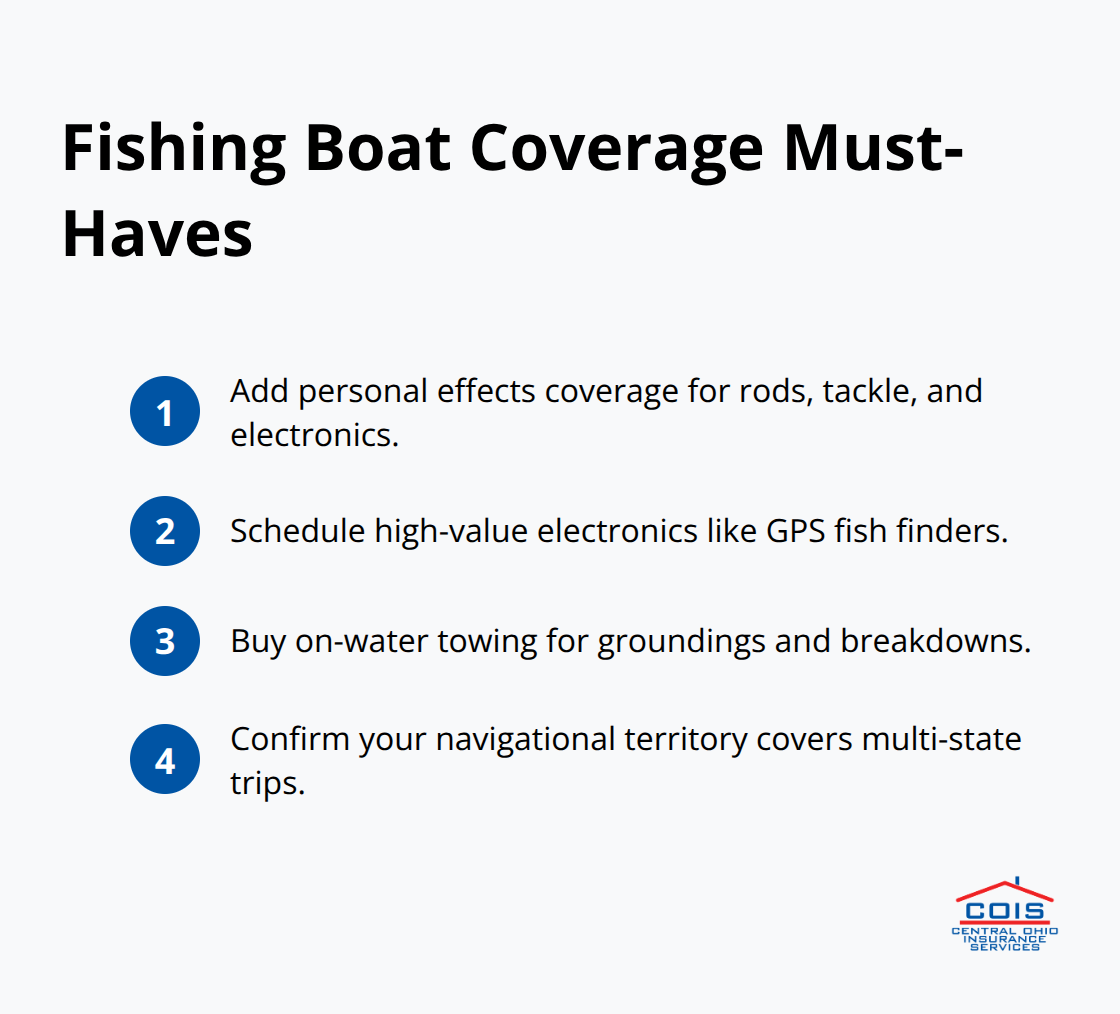
If you fish in multiple states or travel far from your home port, a restricted territory policy will leave you unprotected and claims will be denied.
Kayaks, Canoes, and Jet Skis: Coverage Varies by Usage and Value
Kayaks, canoes, and paddleboards occupy a different category entirely. Most homeowners policies cover these vessels on land for liability, but not on water. If you paddle casually in local parks, your homeowners coverage likely handles basic liability. But if you own expensive gear-a $3,000 kayak with $1,500 in equipment-you need a watercraft endorsement.
Jet skis never qualify for homeowners coverage and always require standalone policies. Progressive reports jet ski insurance costs between $100–$500 annually depending on horsepower and your boating history. The real insight: boat type determines which coverage matters most, not just how much coverage you need. Understanding these distinctions helps you move forward with the right protection in place, which brings us to the specific coverage options that protect you financially on the water.
What Coverage Protects You Most on the Water
Liability Protection: The Foundation You Cannot Ignore
Liability coverage forms the foundation of every boat policy, and it’s where most boat owners make costly mistakes. Your liability protection covers injuries or property damage you cause to others, plus legal defense costs if someone sues you. Progressive and BoatUS data show that marine liability typically starts around $100,000, but that’s dangerously low for recreational boating. Most insurers recommend $300,000 or higher because a single serious injury to a passenger or another boater can generate medical bills, lost wages, and pain-and-suffering claims that easily exceed $100,000.
Many boat owners bundle marine liability with homeowners and auto policies, which can reduce the total cost by 5–15% across all three policies while raising liability limits to $300,000 or $500,000 without proportional premium increases.
Medical Payments: Direct Protection for On-Board Injuries
Medical payments coverage complements liability by covering injuries to people on your boat regardless of fault. It pays directly for medical expenses up to sublimits (typically $1,000–$5,000 per person) when someone gets hurt boarding, leaving, or being towed by your vessel. This coverage prevents small injuries from becoming liability claims and protects you when passengers waive liability rights.
Hull Coverage: Why Settlement Method Matters More Than Limits
Hull coverage and collision protection address physical damage to your boat, but the settlement method matters far more than the coverage limit itself. Agreed value policies pay the full pre-set amount at total loss with no depreciation applied, while actual cash value policies pay only the depreciated market value-and that gap widens dramatically with older boats. For a pontoon or fishing boat worth $15,000, agreed value costs roughly 10–20% more annually but prevents the insurer from paying you only $9,000 for a $15,000 total loss.
Uninsured Boater Coverage: Protection Against Underinsured Operators
Uninsured boater coverage operates like uninsured motorist protection in auto insurance: it covers your injuries or damages if another boater lacks sufficient liability coverage or flees the scene. Since boat insurance isn’t legally mandated in Ohio, Tennessee, or Pennsylvania, many recreational boaters carry zero liability coverage, making uninsured boater protection essential. This coverage activates when someone else’s negligence injures you or damages your boat, and it typically costs only slightly more than basic liability alone.
The right combination of these protections-liability at $300,000 minimum, agreed value hull coverage, and uninsured boater protection-covers both catastrophic scenarios and the gaps that standard policies leave exposed. Understanding how these pieces work together sets the stage for the next critical factor: what actually drives your boat insurance rates.
What Really Drives Your Boat Insurance Costs
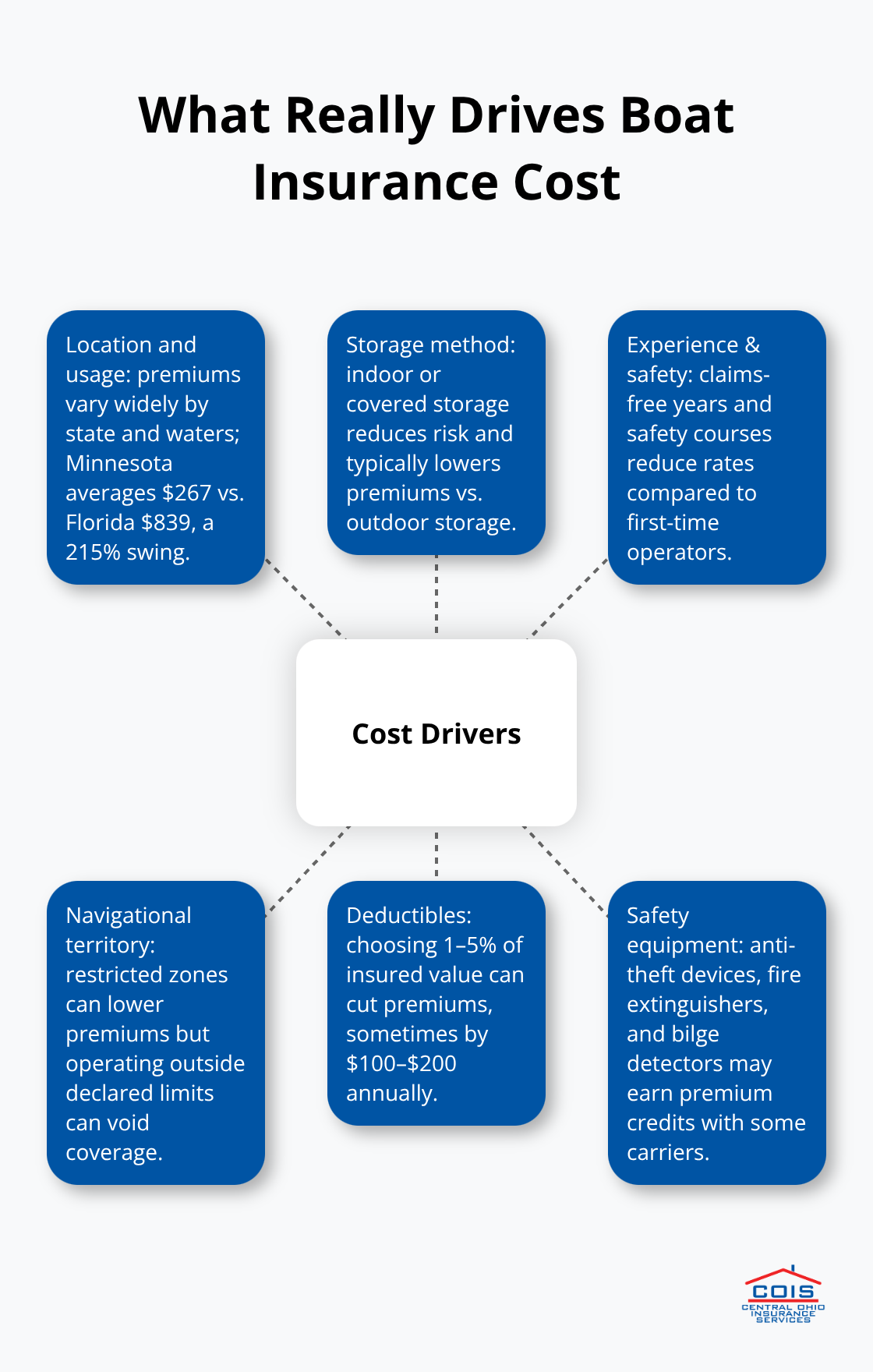
Your boat’s characteristics matter far less than you’d expect-what matters is how you use it and where you keep it. Progressive’s 2023–2024 data reveals the real pricing story: a boat owner in Minnesota pays an average of $267 annually, while the identical boat in Florida costs $839. That’s a 215% difference driven almost entirely by location and usage patterns, not the boat itself.
Location and Water Conditions Shape Your Premium
Boat type certainly factors in-fishing boats with high-horsepower engines cost more than pontoons, and jet skis run higher than sailboats-but your storage method, boating experience, and navigational territory create far larger swings in your premium. A 15-year-old fishing boat stored indoors in Ohio costs substantially less than a brand-new pontoon stored outdoors in Florida, even though the pontoon is technically newer and potentially worth more. The inland waterways of the Great Lakes region drive lower premiums across the board because recreational boating there means smaller vessels in controlled water conditions; coastal states with longer boating seasons and larger offshore boats see premiums jump to $600–$839 annually just from the geography alone.
Your Experience and Safety Record Matter Most
Your boating history matters more than your boat’s age. An experienced boater with ten years of claims-free operation pays significantly less than a first-time boat owner, regardless of whether they pilot a $8,000 kayak or a $50,000 fishing boat.
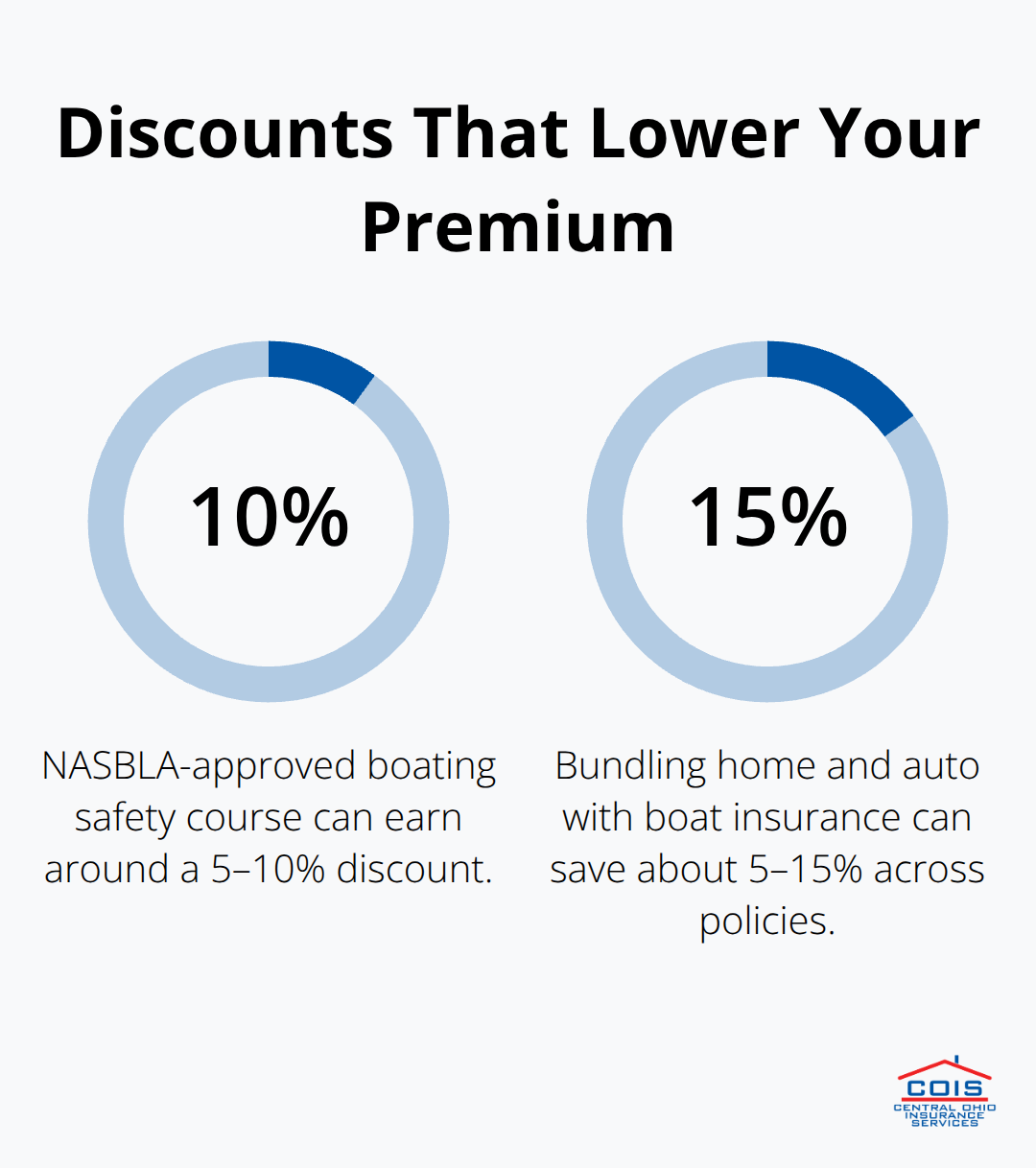
Completing a NASBLA-approved boating safety course typically earns you a 5–10% discount that compounds with bundling discounts-add home and auto policies together and you unlock 5–15% savings across all three policies, potentially cutting your boat insurance from $400 to $300 or less annually.
Storage and Territory Decisions Control Your Costs
Storage location creates one of the largest controllable cost levers available to you. Indoor or covered storage reduces theft and weather damage risk so substantially that insurers reward it with noticeably lower premiums compared to outdoor storage; requesting the longest reasonable layup period-the months when your boat sits unused-can further reduce premiums if you declare your boat out of service during winter months. Navigational territory limits also compress your costs dramatically. If you fish exclusively within 50 miles of your home port, declaring a restricted territory policy instead of full-state or multi-state coverage can lower your premium meaningfully. The trap: many boat owners accept restricted territory limits without understanding the consequences. Operating your boat outside your declared territory voids coverage entirely-a $30,000 claim becomes your responsibility alone.
Deductibles and Safety Equipment Lower What You Pay
Increasing your deductible from the standard amount to 1–5% of your boat’s insured value crushes your premium, sometimes by $100–$200 annually on fishing boats and larger vessels. The calculation is straightforward: if your boat is worth $20,000 and you can absorb a $1,000 out-of-pocket loss after an accident, raising your deductible saves more money annually than most bundling discounts. Older boats sometimes trigger marine survey requirements before underwriters will quote coverage, which adds cost and delay but actually protects you by forcing a professional assessment of condition. Installing anti-theft devices, automatic fire extinguishers, or bilge detectors yields premium credits with some carriers-ask your agent specifically which safety installations generate credits at renewal time rather than assuming all upgrades help.
Final Thoughts
Boat insurance protects your financial investment and shields you from liability exposure that can exceed hundreds of thousands of dollars. The essential coverage types-liability at $300,000 minimum, agreed value hull protection, medical payments, and uninsured boater coverage-form a complete foundation that handles both catastrophic losses and the gaps that leave boat owners exposed. Skipping any of these components creates unnecessary risk, especially uninsured boater coverage, which costs almost nothing but protects you against the reality that many recreational boaters carry zero liability insurance.
Finding affordable boat insurance starts with gathering accurate information about your boat, boating history, and how you actually use the vessel. Get quotes from multiple carriers rather than accepting the first offer-independent agencies can compare 30+ carriers and provide quotes within about an hour. Ask specifically about discounts: NASBLA boating safety courses yield 5–10% reductions, bundling home and auto policies compounds savings to 5–15% across all three policies, and winter layup discounts reward boat owners who store vessels for four to six months.
Increasing your deductible to 1–5% of insured value often saves more annually than any discount, and declaring a restricted navigational territory if you fish or boat locally can meaningfully lower your premium without sacrificing coverage where you actually operate. Review your boat insurance annually-as your boat ages, your boating habits change, or your vessel’s value shifts, your coverage should adjust accordingly. Contact Central Ohio Insurance Services, Inc. to get quotes and ensure your recreational boat insurance guide becomes a personalized plan that matches your boat and your budget.
The information provided in this blog is for general informational purposes only and does not constitute legal, financial, or insurance advice. Coverage options, terms, and availability may vary. Please consult with a licensed professional for advice specific to your situation. Artificial intelligence may have been used to generate text and images in some blog articles and may contain inacuracies.